Friday, July 16, 2010

7-15-10

FOREST HOUSE

SCREEN FOR COMPOST SIFTING

SUPER-DUPER COMPOST

THREE BIN COMPOST SYSTEM

FRESHLY TURNED/WATERED COMPOST

The compost lessons continue. Everywhere we go, everyone uses compost, but everyone makes it slightly differently. Today we learned yet another organic composting system. Carolyn is a huge advocate of heavily watering her compost piles; other people wet their compost, but no one adds this much moisture. There are three bins made of re-purposed wood palates lined up next to each other. One normally has compost that is ready, one has compost that is decomposing, and one is empty. You can use the ready compost when you like, and with that pile, we sifted it through a large screen to filter out any last bigger pieces of wood and branch debris. Everyone has a screening system, and no matter how it's set up, screening compost is really physically challenging. Shaking a hand screen, utilized on other farms, is really a chore, so we thought the permanent screen here would be a breeze. But the angle the permanent screen is set at was hard to work with. We had to be on our knees, scraping the compost through the screen with the backside of a metal rake. It was tough to get the proper leverage from the low angle with a rake whose handle was too long; we are still on the look out for the perfect screening system. We then turned a pile of compost from one bin into the empty one, and alternated it with layers of horse manure, while watering it with a hose constantly. Carolyn's system turns garden waste into finished compost in only 3 months, due to adding manure at the half way point, adding lots of water to speed up decomposition, and also by turning it only once. There are some other mineral rich additives she puts in like comfrey and nettle, so her finished compost looks pretty amazing. We're going to borrow some of these strategies for sure.

It's funny sometimes how one can get worked up over nothing. So the expression goes, don't cry over spilt milk. But when that figurative glass of milk spills and ruins your favorite, most expensive persian rug, tears fall. No tears were actually spilt today, but we felt guilty for something that in all reality was totally meaningless. We harvested favas for dinner in a large basket, and maybe got a bit carried away. We prepared enough favas to feed at least 8, more like 10 people, but there were only 5 of us dining. The fava patch is relatively small, and by taking a lot now, the opportunity to eat favas out of the garden throughout the rest of the summer will be limited. Also, Carolyn sells fava beans as seed, so she can't eat them all anyway. It's no big deal, but at dinner, several comments were made about the abundance of favas on the table, and how the excess tonight will hinder savoring them at other meals over the course of the summer. They tasted great, but somehow, we felt bad about the entire situation. Woe is us.

7-14-10

POLLY WANT A CRACKER?

WHAT DESSERT CAN I BAKE WITH THESE?

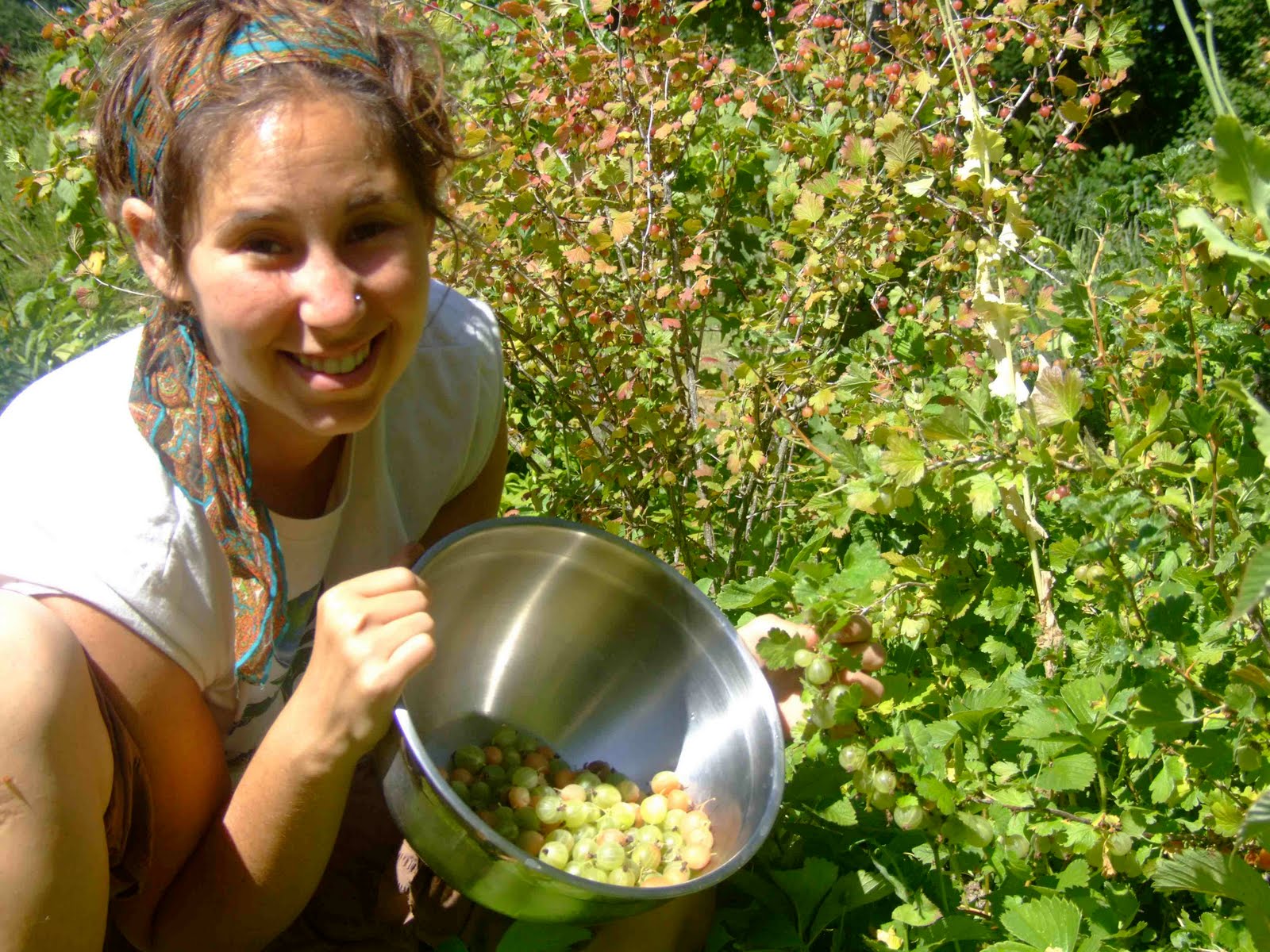
GOLDEN GOOSEBERRIES

RED GOOSEBERRIES

PICK A GOOD ONE!

SOUR CHERRIES

DAMN THAT LOOKS GOOD

DAMN, THAT LOOKS BETTER!

Today was a dream day in the eyes of us WWOOFers. Since our trip began, all we've wanted was to harvest fruit. In the winter we realized that was impossible, but all spring and summer we've been waiting and waiting. Due to the cold and wet weather we've faced everywhere, fruit has been slow to ripen. We've enjoyed a few nibbles here and there, but there hasn't been any substantial production. Today, that all changed.

We kicked off the day by harvesting three types of gooseberries. Gooseberries are a tart, fairly sour fruit that ripens into either a light green/golden, red, or nearly purplish-black. The darkest variety are a hybrid of gooseberries and currants. Biting into ones that aren't ripe nearly makes your mouth pucker, but even the ones that are ripest are just almost sweet. We find the best thing to do with sour-ish fruit is to add sugar and turn them into jam or bake them! Having made salmonberry jam at Green Angel Gardens, a pie was next on the list.

There are also two cherry trees here, one with sweet cherries and one with sour cherries. Two days before our arrival, the birds ate every single last sweet cherry off the tree! Jerks. However, there were plenty of sour cherries they left for us, so our next task was to harvest these. This was a bit more challenging only because we had to climb a ladder on uneven ground to reach the cherries while the wind was blowing us around. We safely picked our way through the tree and came out with over four pounds of cherries! Unlike the gooseberries, none of these cherries are almost sweet; they are so sour you nearly have to spit them out if you attempt to eat one. With all this fruit, there was only one thing left to do: make two pies!

Jen loves to bake, as we all know by now. However, as we travel from kitchen to kitchen, it is often hard to bake in new places, without the tools she likes and is used to. Since we are traveling "lightly" we didn't pack the loads of recipes we have or our favorite cookbooks, so it is often an additional challenge to always have to reinvent a recipe. New recipes and unfamiliar tools are hurdles we've managed to overcome, and our cooking and baking is all the better because of the adversity. We are turning out great stuff, according to everyone who eats what we prepare. We just imagine that when we have our own kitchen, hopefully someday soon, we will be able to hone our culinary skills even further.

Wednesday, July 14, 2010

7-13-10

DIG IT

FIELDS OF GOLD

TAKE THIS VAMPIRES!

GARLIC BULBS

DRYING GARLIC

Our first night here we slept in a bedroom in the basement, but tomorrow, Guy's (Carolyn's husband) sister is visiting from England for vacation and she will be sleeping in that bedroom. So we got "evicted" and are now sleeping in the forest house, which is way better anyway. It is an octagonal structure built from salvaged wood with lots of windows and an incredible woodsy aroma. It has electricity, but no other amenities. It is reminiscent of the shelters we lived in on Moore Farms in AL and Green Angel Gardens in WA, but this cabin is more spacious than both of those.

We spent this morning building a path around our cabin and planting some native plants along it, including a hazelnut tree. It wasn't as easy as just putting plants in the ground, because the area along the path is forest. With the help of Kristen, a German wwoofer, we first had to pull out large brush and fallen debris. Second we raked out the smaller brush and debris to clear out bed areas. Next we loosened the clay soil with pitchforks and pulled out large rocks embedded in the ground. Some rocks weighed well over 100 lbs and it was a strenuous task moving them. With the rocks cleared, we brought in wheelbarrows full of manure and mixed it thoroughly. After that was done, we dug holes and filled them with water before planting; by allowing the water to absorb, we created a more suitable environment for the transplants. Once the water had penetrated the dry clay soil, we threw a few handfuls of rock phosphate in order to help root development. With manure, water, and rock phosphate in place, we finally transplanted. Hopefully the plants will like their new shady home and will flourish, making pretty flowers next spring and summer...and one day edible nuts. Beautifying of the trail: check.

After lunch, we headed into the vegetable garden to harvest garlic. Due to the wet, cold spring and early summer, the garlic fell victim to rust. Just like rust on metal, rust on plants is due to excess water and is an airborne spore disease. Normally after harvest, you can braid the garlic stems and leaves and hang the bulbs upside down to dry out. However, because the leaves and stems were covered in rust, we had to cut the bulbs off and peel back the rusted layers. Luckily the rust only affected the leaves, and the bulbs look great and are perfectly edible. The shot stemmed bulbs minus the leaves are now resting upside down drying in the greenhouse, where they will stay there for 4-6 weeks. Once they are cured, they should last all year long. This activity was one of the finest smelling activities we've participated in on this adventure.

7-12-10

DON'T MIND IF WE DO

RASPBERRIES

TAYBERRIES

SOUR CHERRIES

CHERRY THIEF

WEEPING WILLOW

GREENHOUSE

PRETTY IN PINK

Before we set out to work this morning, Carolyn gave us a tour of her property. There are a plethora of veggies, fruits, and ornamentals growing here, in addition to chickens, ducks, cats, and a dog. This used to be a plant nursery but Carolyn is transitioning from growing mostly ornamental flowers to organic food and she has put a strong emphasis on saving seeds (check out her website: The Garden Path Center). Selling organic seeds is the way her business is now heading. Carolyn is very concerned with food security and as such, she is doing her part to ensure she grows plenty of food for herself and is also trying to teach many local island residents how to save their own seeds and to grow their own food as well. She informed us 96% of the food on Vancouver Island is imported and she is appalled at that staggering figure; Carolyn envisions a future where most food consumed on the island is grown here, and she is working to reduce dependence on foreign food, which is dependent of foreign oil.

Selling seeds means having to grow many varietals of each crop in order to have an extensive seed catalogue. This season Carolyn is growing 45 varieties of tomatoes and we spent a few hours this morning suckering and tying different types of vine tomatoes to stakes. Her goal is to see which varieties grow best in this climate and be able to share these with the local community. Common tomato varieties such as beefsteak, plum, or roma dominate supermarket shelves, however there are more types of tomatoes than we can count and Carolyn wants to give her customers as many options as possible. Depending upon your needs (e.g., slicing, saucing, etc), tastes, and your climate you can plant different types of tomatoes for different reasons. Seed saving seems to be one of the most vital and fundamental parts of gardening and farming which has somehow been overlooked recently. We are thrilled to work with a seed saving expert and to learn how different seeds are saved. You can't stop us, Monsanto!

**In response to recent comments, we do intend to get an autographed copy of Carolyn's book. The Malahat Revue carries most of their instruments with them on their bikes, but there is a traveling van that helps carry some gear, mostly the drums. We'll try to take more ferry photos on the return for those interested in them.**

7-11-10

HORTICULTURE CENTER OF THE PACIFIC

BRIDGE OVER "TRANQUIL" WATERS

ZEN GARDEN TEA HOUSE


THE SIRENS


DRAGONFLY


SHANE PHILLIPS

After checking out of the hostel and breakfasting at Lady Marmalade in downtown Victoria, we headed to Glendale Gardens for day 2 of the Organic Islands Festival. Glendale Gardens is designated as a conservation park devoted to the preservation of the native flora and fauna. There is a winter garden, a Zen garden, a children's garden, a rhododendron garden, an herb garden, and a demonstration garden, just to name a few. The landscape is magnificently manicured and is teeming not just with flowers but also with edible plants. Even if there hadn't been an organic festival, visiting these grounds would have been a treat but the combination was something really special.

On the main stage today were some terrific musical performances, as well as a raw food forum. Four panelists and an additional moderator spoke about the raw food movement. It is our personal belief that eating local while simultaneously eating a raw diet is extremely challenging, unless one lives in a tropical climate. Many people have different items on their agenda when it comes to what is most important about food, and we've noticed most people who follow a strict raw diet have local food way down on their list of importance. For a simple example, avocados and bananas are two raw food staples, and these fruits haven't been growing anywhere we've visited. Marrying the local food movement with the raw food diet seems awfully imposing, unless you are willing to eat a very limited diet.

After the festival, we met up with Carolyn and her husband Guy, and drove to their home just down the road. Along with two of their friends, we all went swimming in a nearby crystal clear lake just before sunset, and it was invigoratingly intoxicating. With wet behinds, we stopped at a local farm store for some produce and whipped up a delicious dinner. We are stoked about this upcoming week, spending time with Carolyn in her garden, eating her berries, and learning from her as much as we possibly can.

Sunday, July 11, 2010

7-10-10

6TH ANNUAL ORGANIC ISLANDS FESTIVAL

GARDEN SCULPTURE

MALAHAT REVUE

HANNAH GEORGAS

CAROLYN HERRIOT

MECHANICAL MOWER MAN


After a blueberry Belgian waffle breakfast, we headed to the Organic Islands Festival, which is ultimately the reason we are on Vancouver Island. We were invited here by the festival's main organizer who read our blog and thought we would enjoy it. She was right and the first day of the two day affair was excellent.

The festival is the biggest gathering of green food producers, green energy producers, green clothing producers, and green advocates on this Island. With over 150 tents featuring fresh farm produce, fair trade clothes, coffees, artwork, and trinkets, information booths, organic fertilizers, compost booths, raw food, and live music, there was something for everybody.

BioFert, an organic fertilizer company, had a booth and we spoke with co-founder and director Yasir M. Syed. He gave us information and lessons about neem oil, which is a natural bug repellant allowed for use on certified organic crops. Neem oil is derived from the pit of the neem fruit grown on the neem tree, which grows in very warm, frost-free climates. Neem oil solutions that one can purchase in a gardening store often contains many other ingredients which are not natural and may be harmful to humans and plants. Utilizing pure neem oil is the most ancient and safe insecticide known to agriculturalists around the world. Spraying pure neem oil properly emulsified and diluted with water is totally safe and your crops will benefit from the applications. However, it is absolutely vital that you use neem oil that contains one percent or less of "other ingredients." Otherwise, you are not getting a pure, organic, safe product. Yasir referenced that in Canada, BioFert is prohibited legally from selling neem oil as an organic insecticide because large chemical companies, namely Monsanto, are trying to patent the use of neem in their concocted chemical insecticides. As a result he was selling neem oil as "leaf shine." After speaking with him and doing our own research on neem oil, we are certain when have our own garden, if we ever have an insect problem we will most definitely go directly to BioFert for some pure and natural neem oil.

Throughout the day, there were different talks and musical performances on the main stage. The Malahat Revue is a collection of eight musicians who are touring Canada and traveling via bike. They are obviously very eco-conscious and concerned about their carbon footprint which is the reason for the biking tour. Their music was great and their bike shorts were hot. They were one of the best live bands we've seen in a while. Their stuff was really fun and really upbeat. If you ever have a chance to see them or get ahold of their music, we recommend you do so.

Carolyn Herriot was the keynote speaker yesterday, and she is going to host us for the next week as we work in her extensive gardens. She has just published her second book, "The Zero Mile Diet" and this event was her book launch. Carolyn gave a stirring and inspiring speech about the dire need to stop our dependance on anything but local organic food, something which is critical everywhere but especially so on an island. After hearing her speak, we are very excited to stay with her and get to talk to her one on one and get to learn more of her theories and practices about gardening and food.

7-9-10

CROSSING THE BORDER

O CANADA


HOSTEL


We left Olympia this morning and headed to Port Angeles to board the Black Ball Ferry that would take us to Vancouver Island. There is only one problem with crossing from the US to Canada via ship, and that is we cannot take a picture with us in front of a "welcome" sign. The ferry landed in the Victoria Port, which is in the Canadian provence of British Columbia. We will likely stay on this large island (290 miles long, 50 miles wide) for a bit over a week, and depending on how things shake out, we will then return to the States.

Somehow, walking around the streets here feels distinctly different than walking around in an American city. Even though we are merely miles from Seattle, it has a different vibe. This city seems more European than American. We haven't put our fingers on why we are getting this initial vibe, but maybe after a few days here we'll be able to pinpoint it.

We're staying at a hostel for two nights in downtown Victoria, and after settling in, we went out to dinner at Re-Bar, a vegetarian restaurant (they also served fish) that sources as many organic ingredients from on the island as possible. We shared a mango/apple/pineapple/ginger/yogurt smoothie with a quinoa salad, yam quesadillas, olives, and a piece of coconut cream pie. After dinner we walked along the harbor, or should we say "harbour" taking in the sights. Before returning to our room, we went to a pub and watched Sister Speak, a duet that played great covers and a few originals. It was a treat to see some good live music and enjoy a local beer.